SBAR Research Synthesis
Acuity-Based Patient Assignment & Systems Integration
The Insight Vector | Informatics Research Summary
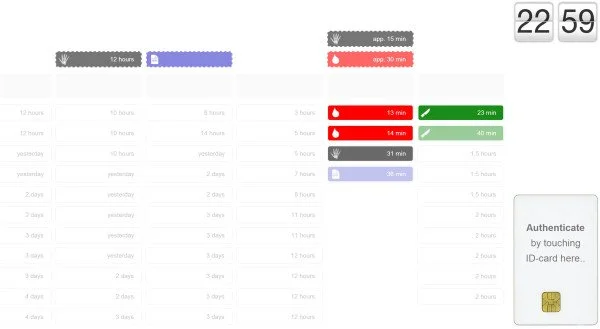
The prototype demonstrates how clinical events can be displayed using de-identified and abstracted information while allowing authorized users to access additional detail. Adapted/reproduced from Gjære & Lillebo (2014), under CC BY 2.0.
Situation
Inpatient assignment models frequently rely on simple headcount ratios, which fail to capture differences in care complexity, telemetry needs, or medication intensity. Managing assignments manually across siloed systems delays alert routing and exacerbates workload imbalances.
Background & Evidence
| Focus Area | Citation | Core Scholarly Finding |
|---|---|---|
| Privacy-Preserving Displays | Gjære & Lillebo (2014) | Digital whiteboards across 15 wards streamlined communication and cut login counts; de-identification models protect PHI while preserving actionable visibility. |
| Perceived vs. Objective Workload | Sir et al. (2015) | Validated that mathematically "balanced" patient counts often fail to distribute perceived nursing workload equitably. |
| Multivariate Acuity Scoring | Thomasos et al. (2015) | Incorporating discrete care demands (medication complexity, telemetry, treatments) reflects true clinical workload better than raw volume. |
| Algorithmic Decision Support | Hurtig et al. (2021) | Demonstrated the CAMEO® staffing algorithm significantly improves assignment consistency in high-acuity pediatric cardiac units. |
| Machine Learning Optimization | Othman, Nashwan, & Abujaber (2025) | Showed ML models can dynamically synthesize census shifts, patient trajectory, and staff competency to support decision-making. |
Assessment
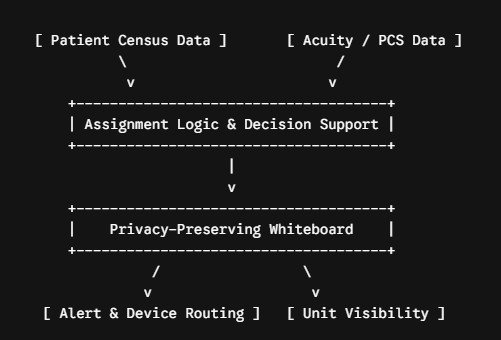
Patient assignment functions as a core informatics bridge between clinical metrics and downstream operational systems:
Dynamic acuity scores, telemetry requirements, medication intensity, and staff competency mix.
Real-time data integration paired with role-based de-identification to maintain privacy.
Research Implications
Research supports consideration of assignment models that extend beyond volume-based nurse-to-patient ratios by incorporating objective measures of patient acuity alongside nurses’ perceived workload. Such models may provide a more comprehensive representation of assignment complexity and workload distribution (Sir et al., 2015; Thomasos et al., 2015).
Algorithmic and machine learning approaches may serve as decision-support mechanisms for synthesizing patient acuity, staffing, and workload variables. These technologies are best considered as tools to inform and support clinical and operational decision-making rather than as replacements for professional judgment (Hurtig et al., 2021; Othman et al., 2025).
Integration of patient assignment data with digital displays and clinical communication systems may improve information continuity across related workflows. Such integration should incorporate appropriate privacy-preserving controls, including de-identification and role-based access, to balance operational visibility with protection of patient information (Gjære & Lillebo, 2014).
References
Gjære, E. A., & Lillebo, B. (2014). Designing privacy-friendly digital whiteboards for mediation of clinical progress. BMC Medical Informatics and Decision Making, 14, 27. https://doi.org/10.1186/1472-6947-14-27Hurtig, M., Liseno, S., McLellan, M. C., Homoki,
A., Giangregorio, M., & Connor, J. (2021). Development and implementation of an inpatient CAMEO© staffing algorithm to inform nurse-patient assignments in a pediatric cardiac inpatient unit. Journal of Pediatric Nursing, 60, 275–280. https://doi.org/10.1016/j.pedn.2021.07.025
Othman, M. I., Nashwan, A. J., & Abujaber, A. A. (2025). Optimising nurse–patient assignments: The impact of machine learning model on care dynamics—Discursive paper. Nursing Open, 12(4). https://doi.org/10.1002/nop2.70195
Sir, M. Y., Dundar, B., Steege, L. M. B., & Pasupathy, K. S. (2015). Nurse-patient assignment models considering patient acuity metrics and nurses' perceived workload. Journal of Biomedical Informatics, 54, 1–12. https://pubmed.ncbi.nlm.nih.gov/25912638/
Thomasos, E., Brathwaite, E. E., Cohn, T., Nerey, J., Lindgren, C. L., & Williams, S. (2015). Clinical partners' perceptions of patient assignments according to acuity. MEDSURG Nursing, 24(1), 39–45.
Independent synthesis of published research for educational and analytical purposes only. Does not constitute clinical, operational, or vendor endorsements.