The Compliance Vector: Why Data Mapping is the New HIPAA Baseline
Healthcare is finally moving at the speed of the modern web. Between FHIR APIs, real-time clinical dashboards, and seamless patient portables, we have opened the doors to incredible care coordination. However, as we open those doors, we often leave the technical windows unlatched. Recent 2026 enforcement actions from the Office for Civil Rights indicate that the Risk Analysis is not a paperwork exercise anymore but is instead a technical mandate to know exactly where your data lives, how it moves, and where it leaves.
The Asset Vector has shifted from hardware to data flows
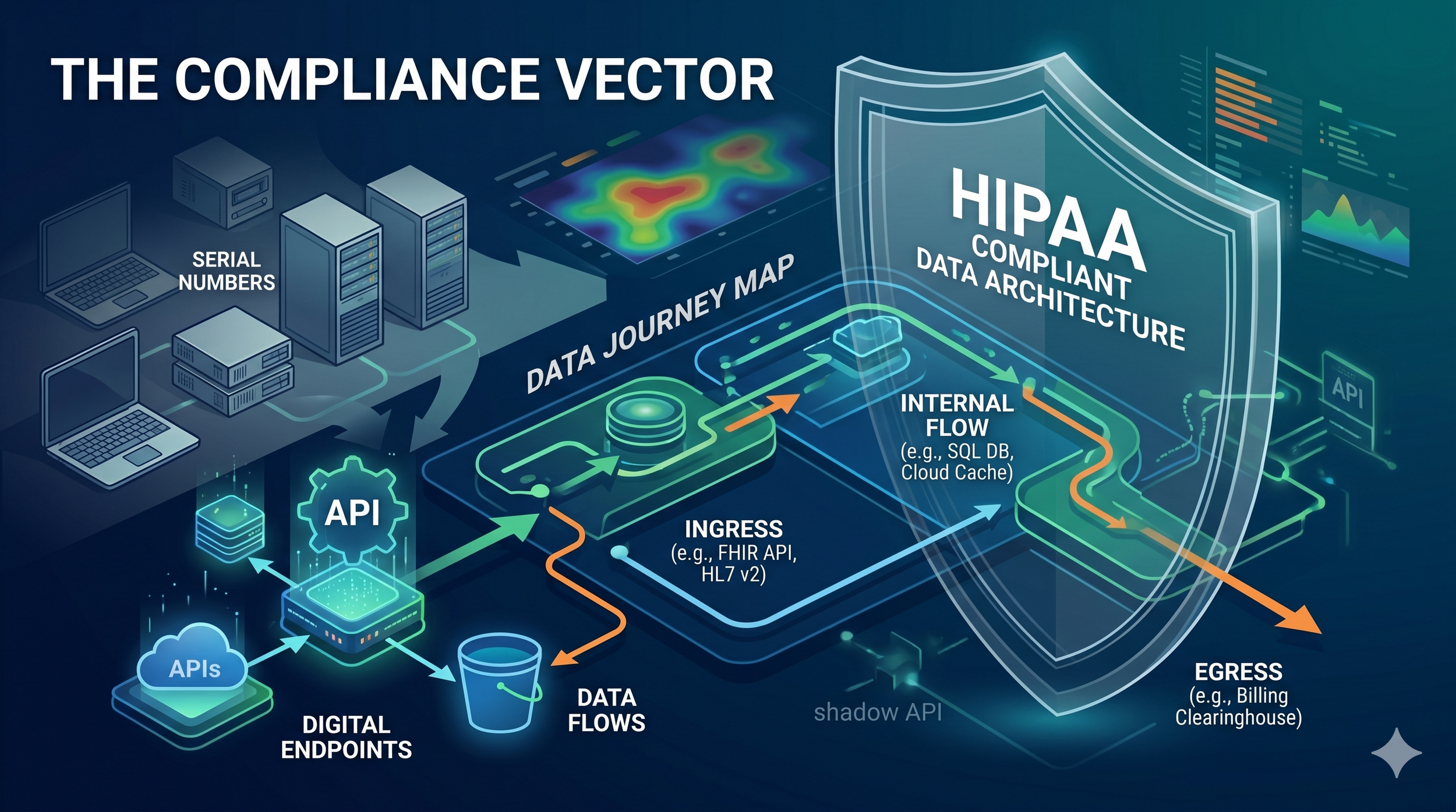
For years, a healthcare asset inventory was often just a list of serial numbers and laptop models. In a world of interoperability, that is a dangerous oversimplification. An asset in 2026 is an API endpoint, a cloud storage bucket, or a FHIR resource. If your risk analysis does not include a map of these digital assets, it is incomplete. The Office for Civil Rights is no longer just penalizing the breach itself but is instead penalizing the lack of visibility that allowed the breach to happen.
Mapping the Magnitude of Ingress Flow and Egress
To stay ahead of the regulatory curve, we have to treat data like a physical supply chain. You must be able to summarize three distinct phases of any clinical data journey. First is Ingress, which is how ePHI enters your ecosystem. This might include legacy HL7 v2 feeds or SMART on FHIR apps. Second is Internal Flow, which identifies where that data sits once it is inside. Is it in a local SQL database or cached on a web server for a Tableau dashboard? Finally, there is Egress, which is where the data leaves. Whether it is a billing clearinghouse or an automated notification, an unmapped exit is a liability.
The Interoperability Intersection of FHIR and Security
Standards such as HL7 FHIR are designed for movement. While they offer robust security frameworks, including OAuth 2.0 and OpenID Connect, the sheer ease of data exchange creates a broader attack surface. A Data Flow Deep Dive is not just about compliance but is instead about interoperability hygiene. When you map your FHIR resources to specific clinical workflows, you are not just checking a HIPAA box but are instead ensuring that your data architecture is efficient, resilient, and ready for the next audit.
The Insight Workbench Shifting to a Live Inventory
Instead of a static annual audit, the modern analyst needs a Live Asset Inventory. This means using network monitoring to identify shadow API calls and utilizing data visualization to create heat maps of data movement. In the current regulatory climate, the statement that you did not know a server had ePHI is a 300,000 dollar sentence. Mapping your data flows is not just a defensive move but is instead the foundation of a modern and interoperable healthcare system.
Summary for the Vector
Asset Shift. Assets are now digital endpoints and data flows rather than just physical servers.
Visibility Mandate. The Office for Civil Rights now prioritizes the Risk Analysis as much as the Risk Management.
Technical Hygiene. Secure interoperability requires real time tracking of Ingress, Flow, and Egress to prevent invisible data leaks.